
Façades and building envelopes
Assess sun-facing façades, spandrel panels and other suitable surfaces. The review balances appearance and generation with wind loading, fixing details, weather protection, fire requirements and access for replacement.
Explore energy-generating façades, canopies and glazing that bring solar thinking into the architecture itself.
Understand the solution ↓Building-integrated photovoltaics (BIPV) combine electricity generation with a building element such as a façade, canopy, roof surface or selected glazing. Unlike a conventional panel added above a roof, a BIPV element must also perform its architectural role. That makes building design and electrical design part of the same conversation.
Solar glass is not one uniform product. Different options offer different levels of transparency, colour, appearance and electrical output. A highly transparent surface may not deliver the same generation as an opaque panel. Orientation, surrounding shade and the way occupants use the space all affect suitability.
The opportunity is best explored early, while the architect, façade consultant and electrical team can coordinate dimensions, connections, access and maintenance. For an existing building, the review must also consider the practicalities of replacing or adapting the envelope.
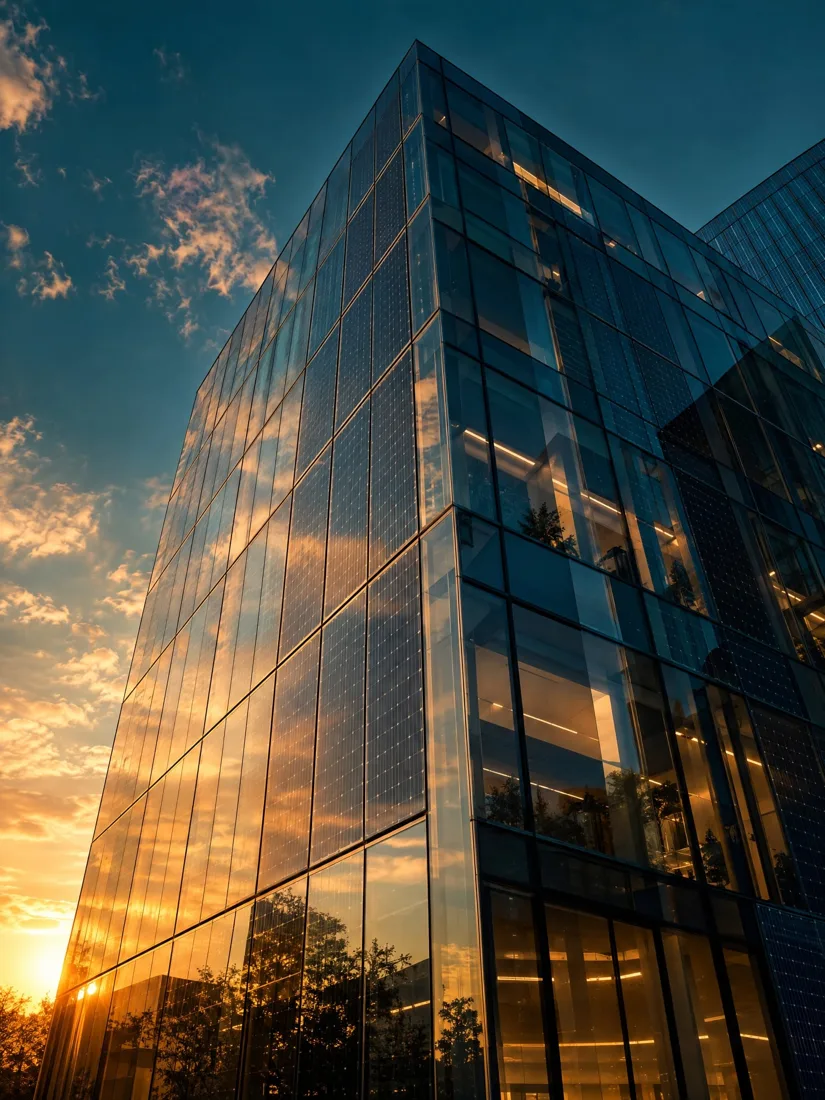
Transparency, orientation, shading, structural requirements, safety and product availability must be evaluated together. LSC remains an emerging research concept; product readiness and availability require separate evaluation.
Architects, developers, commercial buildings, corporate campuses and selected building envelopes.
Assess sun-facing façades, spandrel panels and other suitable surfaces. The review balances appearance and generation with wind loading, fixing details, weather protection, fire requirements and access for replacement.
Explore shading and power generation over entrances, walkways or selected roof openings. Daylight, glare, drainage, structural support and cleaning access need to be considered together—not after the product has been selected.
Compare product maturity, test documentation, warranty support and procurement availability. Luminescent solar concentrators are a research concept distinct from conventional photovoltaic glass; their inclusion in a design requires separate technical and commercial validation.
Understand the building stage, target surfaces, orientation and desired visual qualities. Identify the role the solar element must perform in the envelope.
Evaluate product data, transparency, output, electrical routing and structural interfaces. Establish what needs specialist confirmation or a sample review.
Coordinate responsibilities between the architect, façade supplier, structural designer and electrical team. Confirm procurement, installation interfaces and maintenance requirements before proceeding.
The final engagement is tailored to your site and agreed requirements.
You do not need every detail to begin. Share what you know and we can identify the next information needed.
Explore how generation, architecture, storage and intelligence can work together. Follow the flow of energy from sunlight to useful electricity.
Generation → energy management → site demand & storage
Suitable roof area becomes a source of on-site electricity. Structural checks, shading and electricity demand guide the design.
Discuss suitability for your site